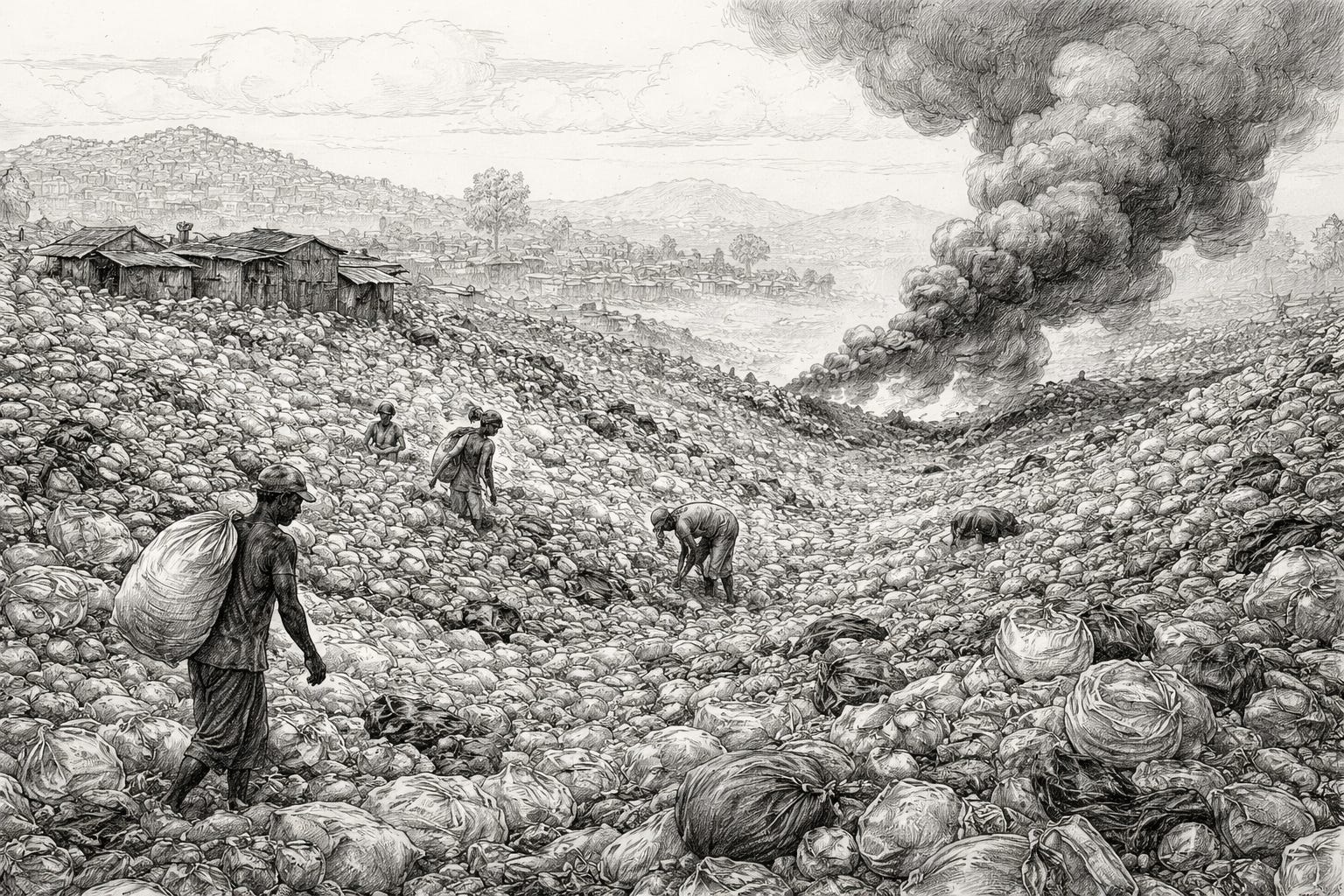
Behold the global circular fraud.
An industry floods the planet with 400 million metric tonnes of petroleum derivatives annually. These derivatives now lodge in human bone marrow. The proposed solution? Have Kenyans walk on it, and then build with it. This is not circular economy. This is 100% circular extraction.
Wealthy nations developed an insatiable appetite for disposable everything. They generated a waste stream of monstrous proportion. Their landfills could not contain it. So they shipped it elsewhere. Container after container of “recyclable” rubbish arrives at African ports. It becomes Africa’s problem.
A young woman in Nairobi devises a method to do something with this imported filth. The very people who sent it applaud her as a sustainability pioneer. She is the founder of Gjenge Makers. Nzambi Matee.
Where did all this plastic originate? Did Kenyan factories produce those PET bottles? Did Nigerian petrochemical plants extrude those polyethylene bags? Did Ghanaian consumers demand single-use packaging for every conceivable product? They did not.
Africa contributes a sliver of global plastic production. The continent is a net importer of plastic waste. Shiploads arrive from Europe, North America, and Asia. Often mislabelled as recyclables. Often nothing of the sort. What cannot be profitably recycled in Brussels or Sacramento gets baled up and dispatched to nations with weaker regulations and more pressing needs. The polluter pays, we were once told. The polluter now poses for photographs.
Microplastics are in human bones. They penetrate bone marrow. They disrupt osteoclasts, the cells responsible for skeletal growth and repair. They impair cell viability. They accelerate cellular ageing. They interrupt skeletal growth in animal models. A review of 62 studies confirms this. Researchers call it an “underrecognised danger.” More accurate: a recognised danger that powerful interests prefer to ignore.
The response from the sustainability establishment? Bricks. Colourful bricks for Nairobi’s pavements. Bricks that will keep fragmenting under ultraviolet radiation, absorbed heat, and mechanical stress. Shedding particles into soil. Into groundwater. Into the food chain. Into the bones of children yet unborn.
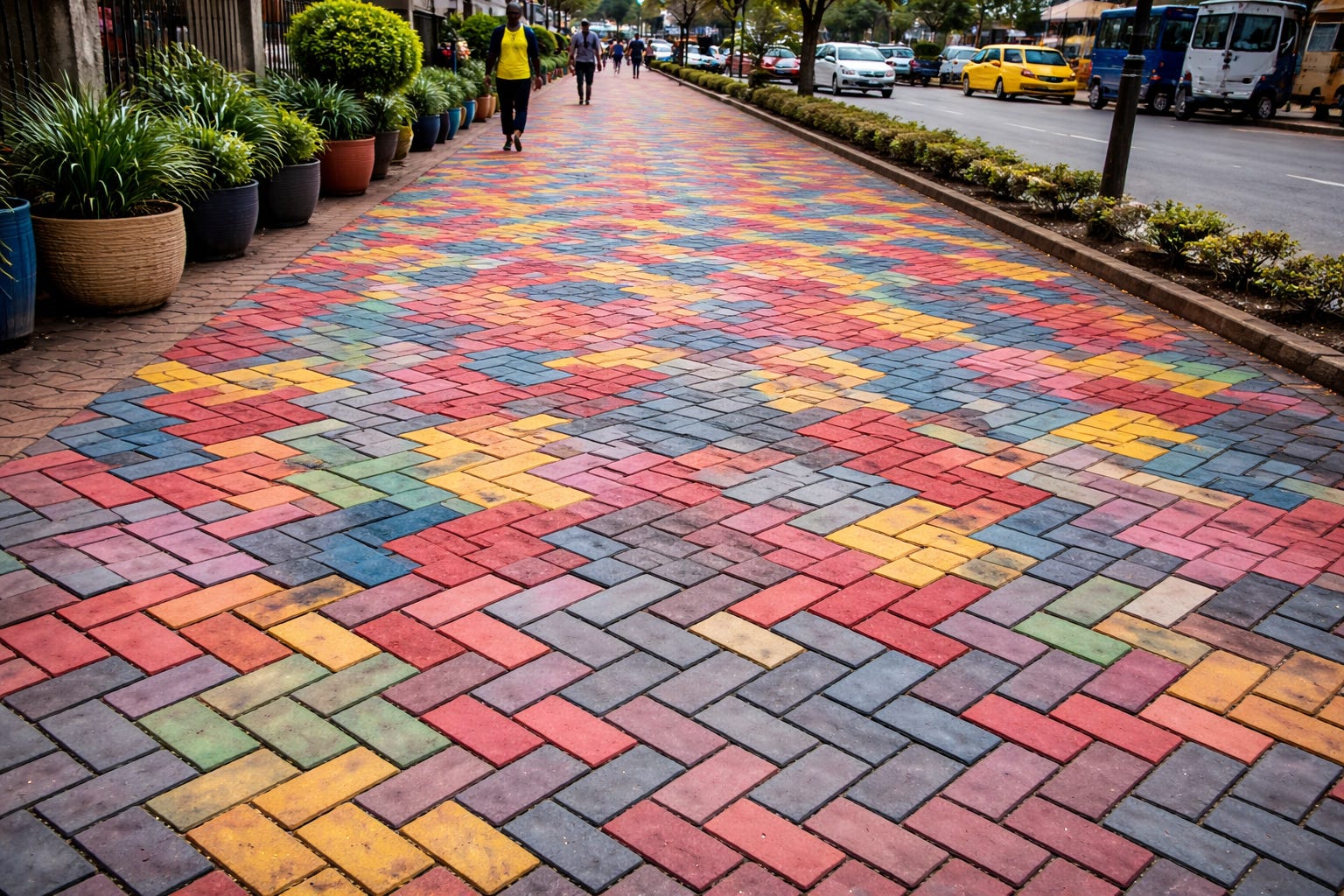
This is not recycling. This is delayed disposal with better optics. Death by a million fragments.
Trace the money. It reveals everything: the extraction architecture.
The Rockefeller Foundation, Osprey Foundation, Stone Family Foundation, and Vitol Foundation seeded the infrastructure. They funded Water Unite, a UK nonprofit chaired by Lord Malcolm Bruce, former Member of Parliament. Water Unite collects micro-levies from bottled water sales. It channels them into “circular economy” projects across Africa and Asia.
The corporate partners are illuminating. Elior UK, British arm of a €6 billion French catering company, donates one penny for every bottle of water sold in its cafeterias. Over £100,000 to date. Britvic joins. Suntory joins. Co-op Group joins. Nisa joins. The pennies accumulate into millions.
Water Unite Impact, the investment arm managed by Wellers Impact, aims to raise $100 million. In October 2024, the U.S. International Development Finance Corporation committed $7.5 million of American taxpayer money to spread these models across the Global South.
Matee’s Gjenge Makers receives their money. So does Mr Green Africa, Sanivation, GREE Energy, and others.
The award circuit blesses the arrangement. Alquity Investment Management co-sponsored Matee’s “Women of the Year Eco-Champion Award” alongside CFC insurance, Elior, and Water Unite. Alquity’s “Transforming Lives Awards” recognised her in 2019. The UN named her Young Champion of the Earth 2020.
The technical development was American. Matee won a scholarship to the United States. She used labs at the University of Colorado Boulder to refine her ratios and build machinery prototypes.
Then came Hollywood. Orlando Bloom executive-produced “Earthbound: Nzambi Matee.” The documentary emphasises “the boundless potential of human ingenuity” and serves as “an optimistic reminder of the impact that each of us can have.”
Each of us. Not ExxonMobil, which knew about plastic pollution for decades. Not Coca-Cola, the world’s largest plastic polluter five years running. Not Nestlé, Unilever, or PepsiCo. Not the petrochemical giants who produce virgin plastic cheaper than recycled because they dump every cost onto the commons. No. Each of us.
The documentary comes with a GoFundMe. Please donate. Help Gjenge Makers build houses from plastic waste. Your twenty dollars will address the problem that corporations manufactured, profited from, and abandoned.
Here is what the sustainability reports will never admit: the perverse incentive.
At scale, Gjenge Makers becomes dependent on plastic waste. Not as a problem to solve. As feedstock. As supply chain. As the very thing that keeps the lights on. American foundations, British caterers, London asset managers, and the U.S. government have bet money on this.
What happens when plastic supply dips? When upstream intervention actually reduces waste? The business suffers. The investors lose returns. The documentary’s happy ending unravels.
The incentives flip. The enterprise that began as a response to plastic pollution becomes, at sufficient scale, a lobby for its continuation. Not explicitly. Never explicitly. But structurally. The books must balance. The machines must run. The expansion requires feedstock.
Water Unite’s model shows the architecture bare. They collect micro-levies from bottled water sales. Their revenue depends on bottled water volume. They fund plastic recycling projects. Those projects depend on plastic waste volume. Everyone profits from the perpetuation of the problem they claim to solve.
The circularity is not economic. It is intellectual. A closed loop of self-justification.
Water Unite’s partner list reads like a roll call of the bottled water industry: Britvic, Suntory, Danone, Gerolsteiner. They donate fractions of pennies from products sold in plastic containers. The donations fund enterprises that require plastic waste. The enterprises create markets for the waste. The markets justify the production. The production continues.
Project forward to the final destination. Gjenge Makers scales across Africa, as the investors intend. The enterprise needs constant, high-volume plastic waste. Where does it come from? The same Global North that produces 400 million tonnes annually. The same shipping lanes that move “recyclables” to ports in Mombasa and Lagos. The waste finds a buyer. The buyer needs the waste. The transaction is reclassified from dumping to development.
The pavers degrade. They must. Physics does not negotiate with press releases. UV radiation breaks polymer chains. Thermal cycling stresses the matrix. Mechanical abrasion from millions of footsteps grinds surfaces into particles. The fragments enter soil. The soil grows food. The food enters bodies. The bodies grow bones.
From Evian bottle to femur. From Dasani cap to vertebra.
The researchers in Brazil are photographing microplastic spheres inside bone cells. Blue against red. Petroleum inside marrow. They note disruptions in osteoclasts. Impaired cell viability. Accelerated cellular ageing. Interrupted skeletal growth. An “underrecognised danger” accumulating in the bones of a species.
The documentary does not mention this. The GoFundMe does not mention this. The UN award ceremony did not mention this. Water Unite’s glossy reports do not mention this.
They mentioned boundless human ingenuity. They mentioned the impact each of us can have. They mentioned circular economy, sustainable development, catalytic finance, and the transformative power of social enterprise.
They have built an extraction structure. Waste flows south. Money flows north. Credit flows north.
American foundations seed the fund. British caterers collect the levies. London asset managers write the cheques. A former MP chairs the board. Hollywood produces the documentary. The UN provides the award. The U.S. government commits millions of taxpayer dollars.
Africans walk on pavements with plastic lodged in it. Soon they will live in homes built from the same material. The perversion completes itself: imported poison re-branded as shelter. Dread becomes gratitude. Waste becomes blessing. The victims learn to love the thing that harms them.
Rain washes the fragments into soil, groundwater, rivers. The particles enter wells, crops, livestock, fish. Children drink the water. Eat the food. The microplastics travel via blood to organs, tissues, marrow.
Their bones collect it.
Ship the waste south, call it circular trade
Brussels walks clean while Nairobi gets played
Rockefeller seeds it, Orlando films the save
Your twenty dollars paves an African grave
Pavers crack, fragments leach, marrow fills with debris
From Evian bottle to femur, that’s the legacy
The West walks forward, immaculate and blessed
Africa carries the bullet lodged deep in its chest
This is not oversight. This is design. The system works as built. The machine of conscience-laundering requires spectacle. A photogenic entrepreneur. Colourful pavers. Uplifting music. A celebrity’s blessing.
Intent is irrelevant. The Rockefeller Foundation did not intend to create microplastic pathways into African children’s bones. Elior UK did not intend to subsidise skeletal damage in Nairobi. Orlando Bloom certainly did not intend any of this.
Intentions are beside the point. The money flows where the money flows. The plastic flows where the plastic flows. The particles lodge where the particles lodge.
Privatise the profits. Socialise the waste. Individualise the solution. Externalise the health costs onto populations that never chose this arrangement.
The circular economy, at last, achieves circularity.
Achebe warned us. Africa carries the West’s deformities. The West walks forward, immaculate. The bullet is now plastic, lodged not in conscience but in bone.
Their bones will tell.