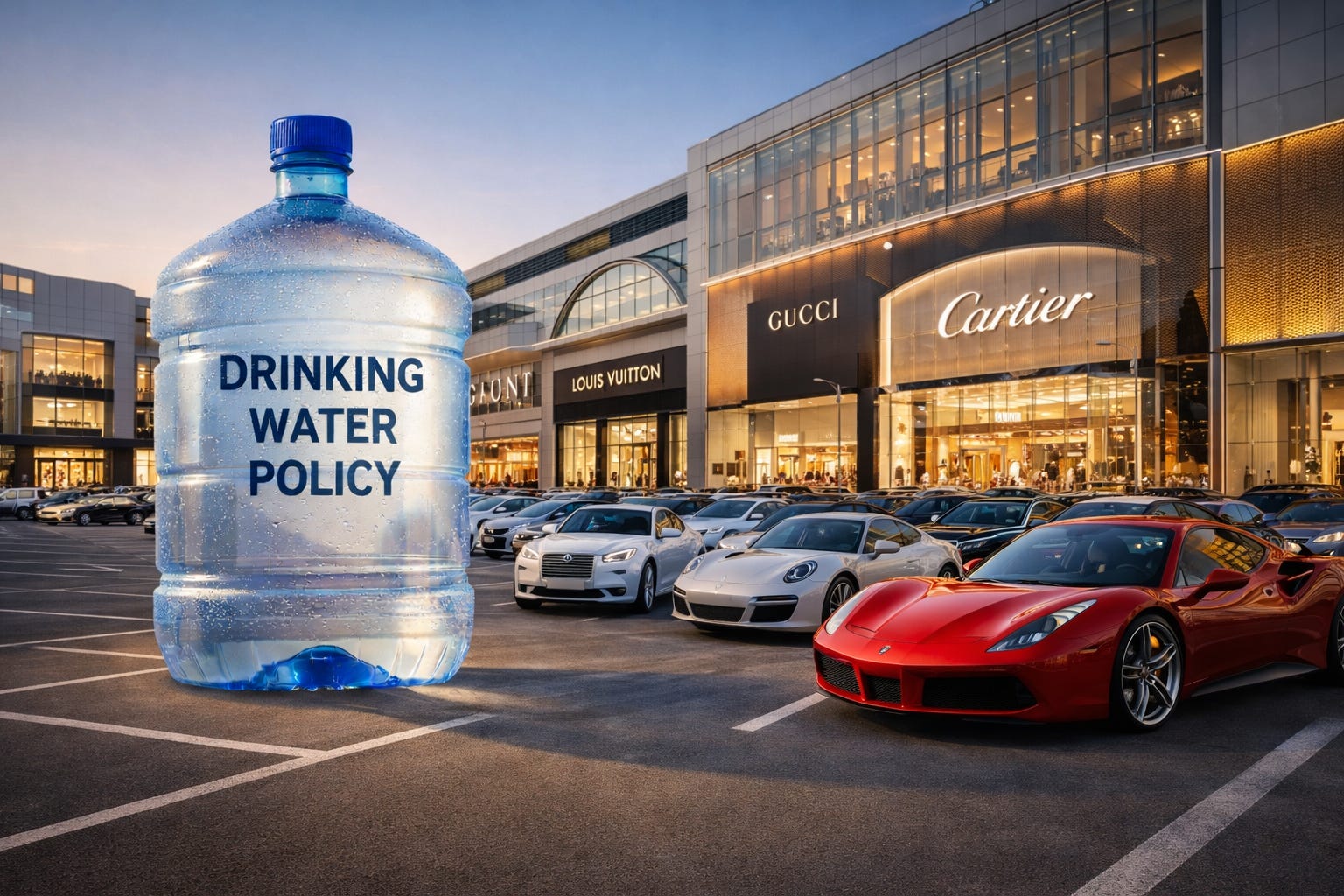
The GCC, flush with petrodollars, has seen monumental economic growth since the 1980s. In the sands of Arabia, capitalism meets consumerism. Land of luxury brands and flagship stores: perception is the product, and brand is the price. Water was always going to end up here.
In the GCC most people prefer drinking bottled water, even though the quality of tap water is excellent. I use bottled water for making a cup of tea and for all cooking as well. But bottled water is not a water business. It is a packaging business with water as the feedstock.
Evian sells Alpine provenance. Volvic sells volcanic filtration. All the leading GCC water brands sell desalinated water in bottles. European brands sell mythology; GCC brands sell the same water that comes out of the tap. A municipal tap sells nothing, because no commercial entity exists with a profit motive to build the brand, and without a brand there is no premium, and without a premium the market stays exactly where it is.
The desalination operator’s incentive ends at the meter. Building customer confidence in tap water directly attacks bottled water sales. In the GCC, that market runs into billions. The two systems are not parallel by accident; no policy exists to force their consolidation.
Branded bottled water sellers do not want customers turning on the tap and feeling satisfied. Every customer that concludes tap water is inadequate is a recurring revenue unit. The trust deficit is a market condition they protect. No bottled water producer funds public confidence campaigns; distrust does the work without a budget line.
Customers across the GCC pay twice, through tariffs and again at retail. The lower the income, the higher the proportional cost of that second payment. The regulatory environment licences both the desalination operators and the bottled water producers without resolving the conflict between them. Whether this is policy failure or policy preference is a question that must be asked and answered.
The building tank problem sits inside the same arrangement. Landlords avoid maintenance costs. Regulators do not enforce end-to-end water quality standards from plant to faucet.
The desalination plant delivers clean water; what happens once it enters private distribution infrastructure is nobody’s legal problem. Customers respond by filtering again or buying bottles. Policymakers call that a perception problem and commission behavioural research.
You can hold a symposium about confidence. You can build trust indices. None of it compels a bottled water producer to surrender market share, a landlord to clean a tank, or a regulator to enforce what is already measurable.
The policy question is not how to make customers feel better about tap water. It is why every party with a stake in the arrangement is incentivised to keep the status quo.
Having manufactured a laissez-faire policy on bottled water, to help the profit machine go ka-ching, it is hypocritical to blame the customer for lacking confidence in tap water. Policymakers must take responsibility, not transfer it.